
A major capital plan does not automatically translate into an equipment purchase order. The commercially relevant questions are who owns the project, who specifies the equipment, who contracts with the supplier, and who delivers, commissions and services it in Canada.
Demand signals worth tracking
Ontario's Independent Electricity System Operator (IESO) forecasts 65% electricity demand growth by 2050 in its 2026 reference scenario, with data centres accounting for 8.6% of total demand by then. These are forecasts, not approved grid connections.
BC Hydro has outlined a 10-year capital plan worth approximately 36 billion Canadian dollars for electrical infrastructure; the plan is being updated and project scope and timing should be checked against subsequent disclosures. To identify addressable opportunities, suppliers and contractors must examine individual projects and awarded procurement packages.
Where equipment and services may fit
- Utilities and substations: transformers, switchgear, protection and controls, cables and field services.
- Data centres and industrial facilities: Uninterruptible Power Supply (UPS), backup generation, Automatic Transfer Switches (ATS), medium- and low-voltage distribution and reliability services.
- Energy storage: Battery Energy Storage Systems (BESS), Power Conversion Systems (PCS), Battery Management Systems (BMS), protection, control, fire-safety and commissioning services.
IESO's Long-Term 1 procurement resulted in approximately 2,194.91 MW of new capacity contracts, including 1,784 MW of energy storage. Electricity capacity contracts with developers should not be confused with equipment procurement agreements.
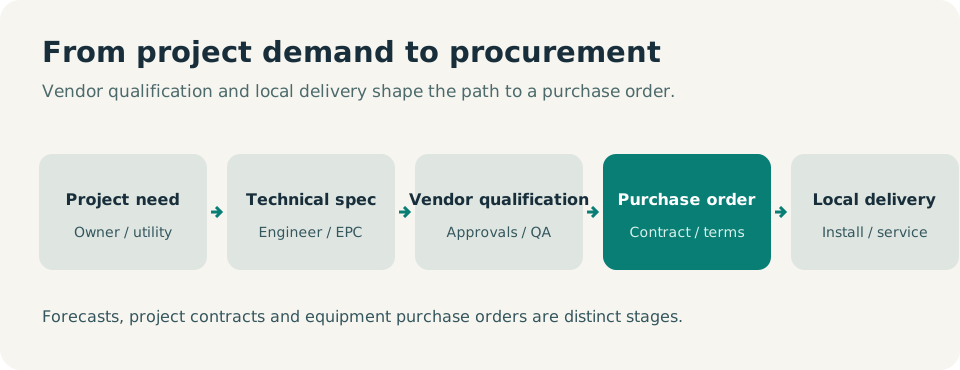
Five procurement-readiness checkpoints
- Classify the stage: forecast, application, approval, project contract, open tender or actual equipment order.
- Map the buyers: utility, asset owner, designer, Engineering, Procurement and Construction (EPC) contractor, Original Equipment Manufacturer (OEM) and integrator.
- Validate suitability: electrical ratings, applicable Canadian standards, recognized product approval and qualification.
- Prepare delivery: Importer of Record (IOR), transportation, installation, commissioning, warranty, spare parts and insurance.
- Enter the right channel: utility vendor registration, engineering contractor onboarding, RFQs/RFPs, or integration partnerships.
The practical differentiator: installability and serviceability
Canadian project teams typically assess not only price and performance, but also engineering documentation, lifting points, module weights, installation clearances, maintenance access and local response capabilities. Ontario's Electrical Safety Authority (ESA) publishes recognized certification and field-evaluation marks; component recognition does not automatically approve a complete end-use product.
A focused 90-day market-validation pathway
Days 1–30: select one product, one provincial market and one buyer segment; prepare technical and compliance materials. Days 31–60: research target buyer organizations and validate specifications, timing and qualification requirements. Days 61–90: advance technical discussions, potential pilots and delivery arrangements. This approach tests commercial fit; it does not promise purchase orders on a fixed timetable.
Partner with CCBONLINE
Based in the Greater Toronto Area, CCBONLINE INC. helps international manufacturers assess and validate Canadian market-entry opportunities, and works with Canadian engineering, procurement and operating businesses seeking qualified international supply partnerships.
Share your equipment category, target province, existing approvals and intended buyer group. We can then discuss a defined readiness assessment or market-validation scope. Describe your project.
Primary sources
- IESO: 2026 Annual Planning Outlook
- BC Hydro: Clean Power Action Plan
- IESO: LT1 procurement results
- ESA: recognized product approval marks
Sources checked October 21, 2026. Market research does not constitute a tender invitation, equipment order, certification approval or guaranteed commercial outcome.